
Guide
Is AI generated content bad for SEO, and what Google actually targets
There are two ways to lose money on this question. Wait for a straight answer and publish nothing, and a year of your site's history goes unwritten. Publish forty articles in a fortnight because the software makes it easy, and you can spend the next quarter unpicking them.
So: is AI generated content bad for SEO? Not in itself, and Google's own spam policies are unusually clear about what is actually being judged. Below is that policy in plain words, the difference between a quiet drop and a message from Google, the five signals that separate an article that is fine from one that is not, and what to do if your traffic has already moved.
Is AI generated content bad for SEO?
No. Writing with a model is not against Google's rules, and the spam policies never name the tool as the offence. What they describe is generating many pages whose main purpose is to move rankings rather than to help the person who is reading them.
Three things follow, and between them they are the whole answer:
- What is allowed. Articles that answer something a real person typed, that are accurate, and that exist because a reader needed them. The software that produced the first draft is not part of the test.
- What is not. Many pages produced mainly to catch search phrases, adding nothing a reader wanted. Scale and intent together, not either one alone.
- What decides which one you did. The result on the page and the reason it exists. Nobody at Google inspects your writing process.
So is AI content safe to publish? On those terms, yes, and the terms are the same ones that applied to a freelancer writing forty pages for the same reason in 2015.
What Google's spam policies actually say
All Google references on this page were checked on 9 September 2026.
Google defines the practice by name. Scaled content abuse, it says, "is when many pages are generated for the primary purpose of manipulating search rankings and not helping users" (Google Search spam policies). The same policy lists, among the examples of how it happens, "using generative AI tools or other similar tools to generate many pages without adding value for users".
Four words in that sentence carry the whole meaning.
- Many. One article is not the subject of this policy. The policy is about production at volume.
- Primary purpose. Not one purpose among several. The main reason the page exists.
- Manipulating. Aimed at the ranking rather than at the reader. A page can want traffic and still be aimed at the reader.
- Not helping users. The measurable half. Whether the page gave anyone anything is a question you can answer about your own pages today.
And the part most summaries leave out: the policy names generative AI as one of the ways scaled content abuse happens, in a list beside older methods such as stitching together text from other sites. It is named as a method, not as a banned tool. The company's guidance on helpful content asks the same question from the other side: who is this page for.
Scaled content abuse, in plain words
Scaled content abuse is making a lot of pages mostly to catch searches, when almost nobody would be glad to land on any of them. Two parts have to be true at once. A lot of pages, and no reader in mind. Ten careful articles a month are not it, however they were drafted. Two hundred pages built from a keyword list are it, even if a person typed every word by hand. Google is describing the factory, not the pen.
Does Google penalize AI content?
There are two different things people mean by a penalty, and they behave differently. One arrives silently, one arrives as a message you can read.
| An algorithmic drop | A manual action | |
|---|---|---|
| Do you get a message | No. Nothing arrives, in any inbox | Yes. Google sends a notice and names the problem |
| Where you see it | Only in your own numbers: falling impressions and clicks in the Search Console Performance report | In the manual actions report in Search Console, which is empty for most sites |
| What causes it | Google's automatic ranking systems reassess your pages, often after a broad update to those ranking systems | A reviewer at Google looked at the site and applied a policy by hand |
| What to do | Improve or remove the weak pages and wait for the pages to be fetched again | Fix what the notice names, then use the reconsideration request in the same report |
| How long it takes | No fixed period. Some pages are reassessed in weeks, some at the next broad update | The review is processed after you request it, and Google gives no promised time |
Most people who suspect a penalty have the first one. A site with a manual action is told about it, which is why the empty report is worth opening before you spend a weekend theorising.
What separates an article that is fine from one that is not
Not "write quality content". Five signals you can check on your own pages this afternoon.
| Signal | When it is fine | When it is not |
|---|---|---|
| Why the page exists | Somebody asked this, and the page answers it | The phrase had search volume, so a page was made for the phrase |
| Where the topic came from | Real search demand, or a question your customers actually ask | A model was asked for fifty blog titles about your industry |
| Whether anything in it is checked | Numbers, dates, names and quotes were opened at the source | Nothing was verified, and nobody could tell you which claims are shaky |
| How many went out at once | A pace a reader could plausibly keep up with | Forty pages in a week on a site that had twenty |
| Whether a person can stand behind it | Somebody would defend every claim in a room | Nobody has read it end to end, including you |
The second row is where most of the damage starts. Topics invented by a model tend to describe an imaginary market, which is why topic selection based on real demand matters more than drafting quality. Good AI SEO content software takes topics from professional SEO data pulled by API, the class of data behind tools such as Ahrefs, and from your own Search Console history where you connect it, rather than from a model's guess about your industry.
How to check whether your own pages look like scaled content
Five checks, all free, all by hand, in this order.
- Read three of your own articles at random and finish this sentence about each: this page exists because. If the honest ending is "we wanted the search phrase", you have found your first candidate for rewriting.
- Open the Performance report in Search Console and look up those three pages. A page with no impressions at all after several months is not being shown to anyone, which is a fact about the page rather than a punishment.
- Find two of your pages on the same subject and decide which one should win. Near duplicates split your own signals, and this is the most common self inflicted problem on small sites.
- Open the manual actions report. It takes ten seconds and it separates two completely different situations. Empty means no reviewer has acted, whatever else is going on.
- Line up the date your impressions fell against the date you published a batch. If the two are within a fortnight of each other, that is worth investigating. If they are six months apart, look elsewhere before you delete anything.
One honest limitation on our side: Kitto is new, so there are no independent reviews of it for you to read yet. What we can do is show the work on your own site first. If checking forty pages by hand is not realistic, you can run a free SEO audit instead: it crawls every page we can reach, marks the thin and the near duplicate ones, and puts the list in priority order, with no card and no account. The what an SEO audit includes guide describes the same six areas so you can do it yourself if you would rather.
What to do if your traffic already dropped
The order matters more than the speed, and the first step is the one people skip.
- Do not delete everything. A mass deletion removes the evidence along with the problem, and you will want to know later which pages were which.
- Sort the articles into two piles: written to answer something, and written to fill a slot. Be strict with the second pile. You already know which is which.
- Rewrite or remove the second pile. Rewriting is usually better, because the address keeps whatever history it had. Removal is right when there is nothing under the page worth keeping.
- Leave the edit dates alone and give the pages time to be fetched again. Nothing you do on Tuesday shows up on Wednesday.
- Watch your own pages in Search Console, not the site total. The total hides the thing you are trying to see, which is whether the pages you fixed moved.
Now the part that most pages on this subject leave out. Nobody can promise that your traffic returns to where it was, and we are not going to be the exception. Search results move for reasons that have nothing to do with you, competitors publish, and Google changes its systems several times a year. Cleaning up pages that were made for volume is worth doing because the site is better afterwards. Treat any recovery as a possibility rather than a plan.
What a tool can and cannot do about this
Software helps with the mechanical half of this and cannot touch the other half. Being clear about which is which is the only useful thing a vendor can say here.
What a tool can do
- Check the claims that carry a number, a date, a name or a quote against sources, and mark whatever it could not confirm rather than quietly deleting it, so you can see exactly what to look at. That is the job described in the fact check an AI article guide.
- Hold a draft that fails its checks so that it never reaches your live site.
- Keep the pace sane. Kitto publishes at most two articles a day for one site, as a property of the software.
- Let you see the first few articles before anything goes out, or let them go out on their own once you are comfortable. Which of the two is yours to choose, and the review mode or autopilot guide sets out both.
What a tool cannot do
- Supply your experience. Google's guidance sums this up as E-E-A-T, meaning experience, expertise, authoritativeness and trust (Google Search Central). It is a judgement your readers make, not a check a crawler runs.
- Promise you positions or traffic. No tool can, and one that does is describing a hope.
- Take responsibility for what is published. Your name is on the page.
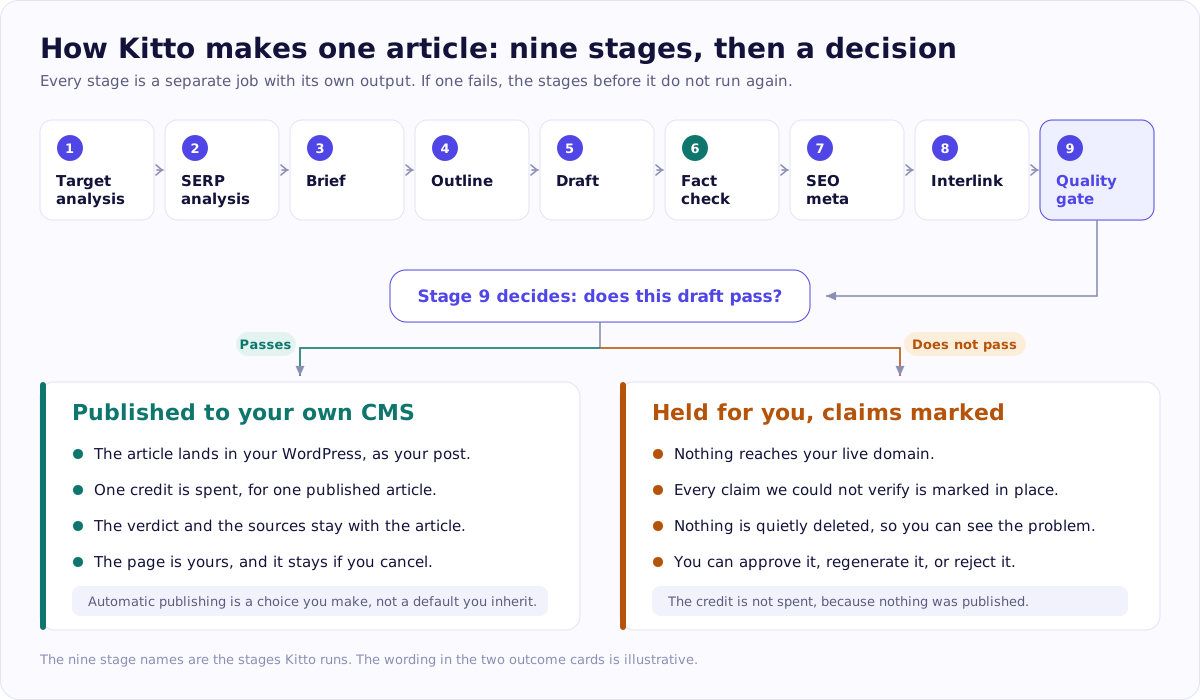
Where the checking sits: at the end, before anything reaches your domain. Look at the two arrows out of the last stage. One publishes, one holds the draft with the unconfirmed claims marked, and neither of them decides whether your subject was worth writing about. The stages and the wording are illustrative.
Questions people ask about this
Can Google detect AI written content?
Google publishes no detector and its spam policies do not describe one. The policies judge what a page is and why it was made, not which software typed the first draft. Treat any percentage you read about detection accuracy with care: nobody outside Google can measure this, and we are not going to invent a number for you.
How many AI articles a month is too many?
There is no number in the policy, and anyone quoting one is guessing. What the policy describes is scale relative to purpose: many pages made mainly to move rankings. As a property of our own software rather than a Google threshold, Kitto publishes at most two articles a day for one site.
Do I need to disclose that an article was written with AI?
Google has no rule requiring it. Whether you say so is a decision about your readers and your own standards, not a search requirement. If your audience would feel misled to find out later, that is a good reason to mention it, and a line in your about page is usually enough.
Will my site recover if I remove AI content?
Sometimes, and nobody can promise it, including us. Removing or rewriting pages that were made for volume rather than for a reader is the right thing to do on its own terms. What happens afterwards depends on your site, your competitors and Google's own systems, none of which anyone selling you a tool controls.
Do search engines penalize AI content?
Google's spam policies do not target AI as such. They target scaled content abuse, which Google defines as generating many pages mainly to manipulate rankings rather than to help people. The policy names generative AI as one way that happens. The method is what is judged, not the tool.
Is AI content against Google's rules?
No. The spam policies name a practice, not a piece of software, and Google's own guidance on helpful content asks who a page is for rather than how it was typed. An article written with a model, checked, and genuinely useful sits outside the policy. A hundred near identical pages do not, however they were typed.
Where these facts come from
- Google Search spam policies: scaled content abusechecked 9 September 2026
- Google Search Central: helpful content and E-E-A-Tchecked 9 September 2026
- Google Search Central: a guide to Google Search ranking systemschecked 9 September 2026
- Search Console Help: manual actions reportchecked 9 September 2026
- Search Console Help: Performance reportchecked 9 September 2026
