
Guide
How to fact check AI generated articles before you publish them
The name under the article is yours. The model that drafted it does not get quoted, corrected or emailed by an annoyed reader, and it will not remember the sentence a year from now when somebody screenshots it.
That is the whole case for knowing how to fact check AI generated articles before you publish them, rather than after. Below are seven steps, five of which take a minute or two, the five kinds of claim that break most often, the check almost nobody does on a citation, and a ten point list you can run with the draft open in the next tab.
How to fact check AI generated articles in seven steps
Work through a draft in this order, because the order is what keeps the job to twenty minutes instead of an afternoon.
- Pull out every claim that carries a number, a date, a name or a quote. Those four are where errors live. Prose without them is rarely wrong in a way that matters.
- Check the expensive ones first. Anything about health, money, law or a named person goes to the top of the list.
- Open the source rather than trusting the label. A confident sounding publication name is not evidence that the page says what the draft claims.
- Find the exact sentence. Not the right site, not the right report: the sentence.
- Check that the source itself is real. Links break, and some were never alive.
- Decide what to do with anything you could not confirm. There are three honest options and they are set out below.
- Record who checked it and when. One line at the bottom of your own draft is enough, and it saves the next argument.
Most of the work is step one. Once the claims are listed, the fact check ai content part is mechanical, and it is the listing that people skip when they are in a hurry.
The five claim types that break most often
| Claim type | What usually goes wrong | How to check it in under a minute |
|---|---|---|
| Numbers and statistics | The figure is real but from an older edition, or it is a retelling of a retelling and the original said something narrower | Search the exact figure with the subject. If the first thing you find is another article rather than the study, keep going until you reach the study |
| Dates and timelines | The event is real, the year is off by one, or two events are put in the wrong order | Check the date on the primary announcement, not on the news story that covered it |
| Names, titles and job roles | The person exists and the job title is two years out of date, or two similar names have merged into one | Open the organisation's own page for that person before you name them |
| Direct quotes | The words were said by somebody else, said in a different context, or never said at all | Search the quoted phrase inside quotation marks. If only your draft and nothing else uses it, treat it as unsaid |
| Citations and links | The link is dead, the page exists but does not contain the claim, or the study cannot be found anywhere | Open it and read the relevant passage. This is the check almost everyone skips, and the next section is about it |
Two rules make the table faster. If a claim would change somebody's decision, check it even when it looks ordinary. If a claim is decorative, consider cutting it rather than spending ten minutes on it.
Check the citation, not just the source
A source can be entirely real and still not say what your draft says it says. This is the most common genuine mistake in a machine written article, and it survives every check that stops at "is this a reputable site".
Four actions, in order.
- Open the link. Not the homepage of the publication, the page being cited.
- Find the sentence that supports the claim. If you cannot find it in two minutes of reading and searching the page, it probably is not there.
- Compare what the source states with what the draft states. Read them side by side rather than from memory.
- When they differ, correct the draft, not the source. This sounds obvious and is the step people get wrong, usually by keeping the sharper wording because it reads better.
That is how to verify AI sources in practice: not by judging the domain the link points at, but by finding the sentence and reading it next to your own.
Here is the shape of it, written as an example rather than reported from a real page. A source says "around a third of small sites reported some improvement". The draft says "34% of small sites improved". Those are different claims: one is an approximation with a hedge, the other is a precise measurement with the hedge removed. The fix is to write what the source wrote.
Spotting a source that does not exist
Four signs, any one of which is enough to stop and look harder.
- A DOI that does not open. A DOI is the permanent identifier printed on academic papers. A real one resolves to a real paper.
- A tidy, sensible looking web address that returns a 404, meaning the page is not there. Invented links often look more plausible than real ones.
- A convincing study title that appears in no database, and in no search result other than your own draft.
- A publication page that exists but has no such article, sometimes with a real author attached to a piece they never wrote.
Treat all four the same way. A source that does not exist is not a formatting error, it is a missing claim, and the sentence goes with the link.
What to do with a claim you cannot verify
Some claims will not resolve. You looked, the source is not there or does not quite say it, and the deadline is real. Three options, and only three.
- Confirm it. You found the source and the sentence. Cite it properly and move on.
- Cut it. The text does not need the claim. Removing it costs you nothing and the paragraph usually reads better.
- Mark it and leave the decision visible. The claim matters to the argument, and you could not confirm it. Say so in the draft, in a way the next person will see.
The third option is the one worth defending, because deleting by default feels tidy and quietly destroys information. A cut claim leaves no trace, so in a month nobody remembers there was a gap there, and the same shaky figure gets rewritten in by somebody else. A marked claim keeps both the text and the knowledge of its weak point. In Kitto the quality gate works this way on purpose: it marks in the draft whatever it could not confirm rather than cutting it out, so what you see before publishing is a short list of the things worth your attention. Who looks at that list, and whether anything waits for you at all, is a separate decision covered in the review mode or autopilot guide.
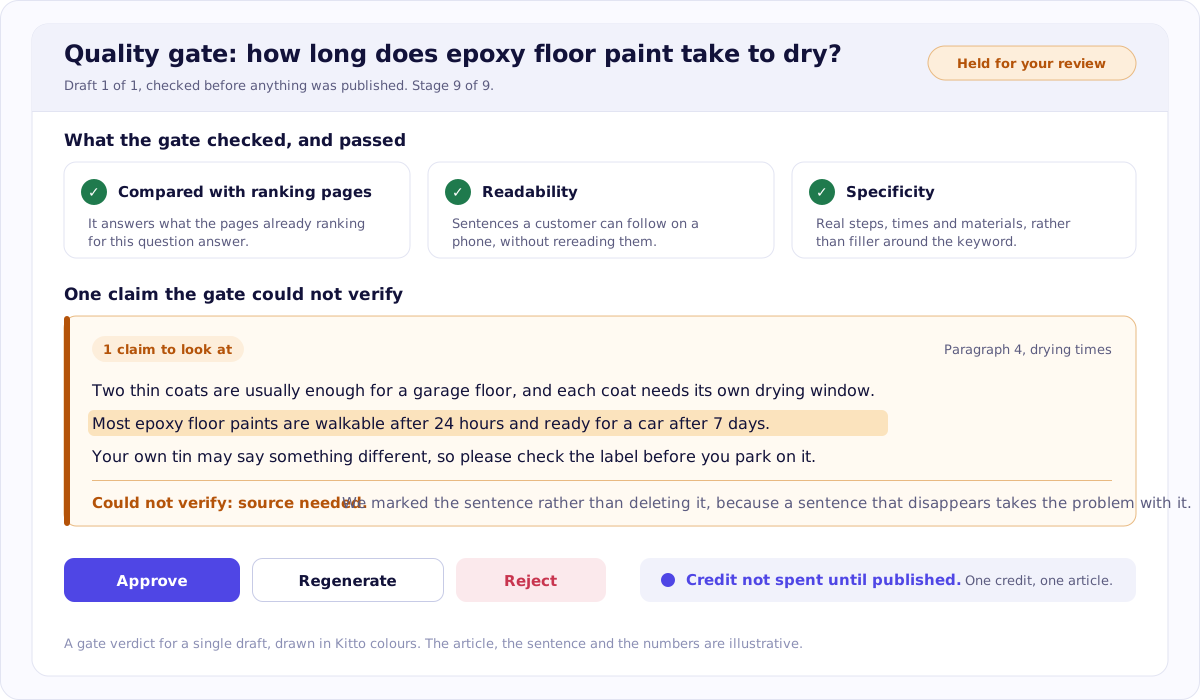
What "mark it" looks like when software does it. Look at the highlighted sentence: the claim stays in the draft with a note attached, so the decision is still yours to make. The article, the checks and the wording are illustrative.
A checklist you can run in ten minutes
Ten lines, each answerable yes or no, in the order that keeps the job short.
- [ ] List every claim in the draft that carries a number, a date, a name or a quote.
- [ ] Order that list by what an error would cost, most expensive first.
- [ ] Open every link the draft cites, one by one.
- [ ] Find the exact sentence in each source that supports the claim.
- [ ] Check each date against the primary announcement rather than a news story.
- [ ] Search each direct quote in quotation marks and confirm who said it.
- [ ] Check every name, job title and organisation against that organisation's own page.
- [ ] Confirm that each cited study or report exists and is findable by somebody else.
- [ ] Decide confirm, cut or mark for every claim you could not verify.
- [ ] Write the date and the name of whoever checked it at the bottom of the draft.
One honest limitation on our side: Kitto checks the drafts it writes, and it does not fact check an article you wrote somewhere else. What we can look at is what is already published on your site, so if that is the more useful half today, run a free SEO audit instead: no card, no account, and the findings are yours to keep. The what an SEO audit includes guide sets out the same six areas if you would rather do it by hand.
Can an AI writer that cites sources be trusted?
An AI writer that cites sources is now common, and a citation is not the same thing as a check. That distinction is the whole answer, and it has three parts.
First, plenty of tools on this shelf do attach links, and some search the web while drafting. That is genuinely useful and it is where the category has improved most. Second, attaching a link and comparing the claim against what the link says are different pieces of work, and the second one is much rarer. Ask a vendor whether the tool shows you the claims it could not confirm; the answer separates the two quickly, and it is a fair question to put to any AI SEO content software before you pay for it. Third, none of this moves the signature. The article goes out under your name, and the ten minutes above are the price of that.
If what you are really asking is whether publishing this way puts your site at risk, that is a separate subject with a clear answer from Google's own policies, and the is AI content safe for SEO guide covers it, along with what those policies do and do not say about volume.
Questions people ask about this
How accurate is AI generated content?
It varies with the subject and with how many claims carry a number, a date or a name. A general explainer of something well documented tends to come out close to right. A paragraph full of statistics is where the trouble is. Rather than trusting an average, sort your draft by claim type and check the expensive ones first.
What is an AI hallucination?
A hallucination is a confident statement a language model produces that is not true, and sometimes a source that does not exist at all. It reads exactly like the sentences around it, which is the whole difficulty: nothing in the tone tells you which sentence to doubt.
How long does it take to fact check an AI article?
On our own process, an article of ordinary length takes about ten to twenty minutes with the checklist below, and longer the first few times while you learn where a draft usually breaks. That is an observation from how we work rather than a promise about how long yours will take.
Which AI writer cites sources?
Several tools on this shelf attach links, and we are not going to hand you a list of names that will be out of date by next quarter. Ask for the property instead of the brand: does it compare each claim against the source it cites, and does it show you the claims it could not confirm? Those two questions separate a citation from a check.
Should I delete AI claims I cannot verify?
Not by default. Deleting hides the problem: a month later nobody remembers that something was missing there. Confirm it if you can find the source, cut it if the text does not need it, and otherwise mark it and leave the decision visible to whoever publishes the piece.
Do I need to fact check AI content if it is just a blog?
Yes, for the same reason you would check a piece you wrote yourself. The name on the page is yours, and a wrong figure in a blog post is quoted onwards exactly like a wrong figure anywhere else. The checklist below is ten minutes, which is about the length of one wrong number's life before somebody repeats it.
Where these facts come from
- Google Search Central: helpful content and E-E-A-Tchecked 9 September 2026
